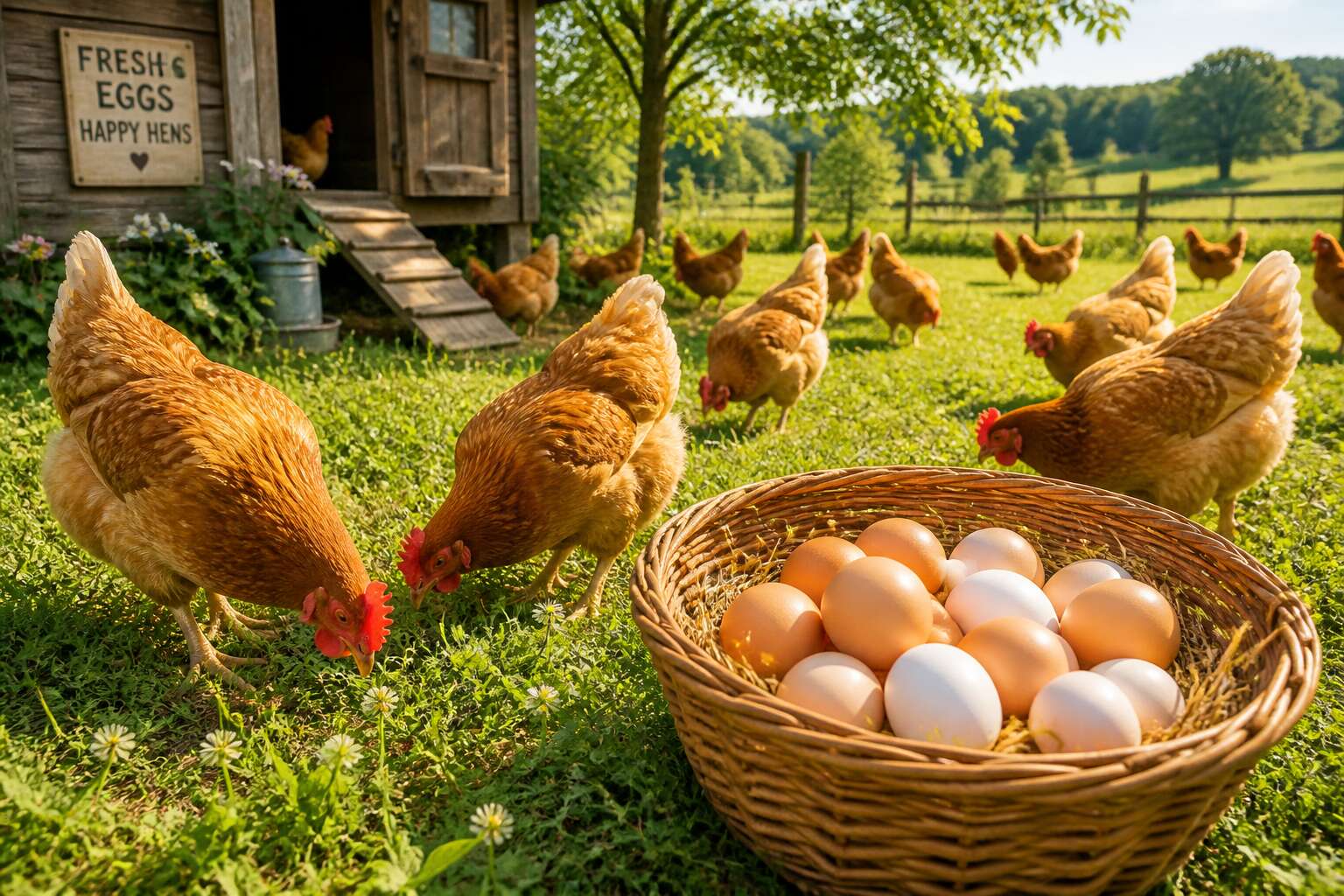
Choosing the Right Chicken Breeds for Egg Production
Top Laying Breeds
A single Lohmann Brown hen can lay more than 300 eggs in her first laying cycle. For anyone entering chicken farming for eggs, that number makes breed selection the first critical decision.
South African conditions, from the Highveld chill to coastal humidity, demand hardy genetics. In my experience, the Hy-Line Brown and Bovans Brown tolerate heat while maintaining consistent shell quality. Free-range operators often prefer the Rhode Island Red, a dependable heritage breed whose annual yield sits below the commercial hybrids.
- Lohmann Brown: exceptional feed conversion and calm temperament
- Hy-Line Brown: robust health and strong shells
- Australorp: a local favourite, steady layers even on marginal feed
Breed choice also shapes your daily routine. Feather pecking, broodiness, and noise levels vary widely between strains, so match the bird to your management style. The right genetics make chicken farming for eggs a quieter, more predictable pursuit.
Climate Considerations
South Africa’s climate dictates breed performance more than any input. The Highveld’s freezing winter nights and scorching summers stress birds, culling egg output. Coastal humidity brings shell rot and feather loss. When planning chicken farming for eggs, start by mapping your local temperature extremes. Then select strains acclimatised to those peaks. A breed that thrives inland may struggle near the sea, and vice versa.
I’ve watched a hardy Sussex thrive through a Karoo heatwave while a nervous White Leghorn dropped production, so temperament matters as much as genetics. Comb colour and wing posture reveal heat or cold stress,and housing, ventilation,and shade often need adjustment. A bird’s genetic predisposition remains the foundation of consistent laying,but no breed can outwork a mismatched climate.
Egg Color and Size Preferences
There is a quiet economics to the egg itself, a calculus that extends far beyond the henhouse. In South Africa, the colour of the shell on your breakfast plate is rarely a matter of chance; it is a direct response to consumer demand. The national palate has long favoured the brown egg, a preference that dictates the flock composition for most commercial chicken farming for eggs operations. White eggs, while perfectly nutritious, often linger on supermarket shelves in certain provinces, a remnant of a bygone era when the Leghorn dominated. This is not a trivial aesthetic concern. The premium paid for a specific shell colour can be the difference between a sustainable venture and a constant struggle.
Beyond the shell, the yolk itself carries a story of nutrition and market positioning. A deep, orange yolk signals a diet rich in maize and marigold extract, a feature prized by home bakers and health-conscious buyers. The size of the egg also shifts the profit margins. Small and medium eggs are the workhorses of the baking industry, while the large and extra-large grades command a higher price at retail. For the independent farmer, this creates a strategic choice.
– Determine your target market. Do you sell directly to a bakery requiring consistent medium sizes, or to a neighbourhood that demands jumbo eggs?
– Assess the breed’s typical egg weight. A Sussex might produce a large egg, while a Rhode Island Red often lays a slightly smaller one, though with greater frequency.
– Observe the shell integrity. A brittle shell is a costly problem, leading to breakage and a downgraded product, a factor often overlooked in the initial excitement of choosing a breed.
The breed you select ultimately becomes a statement of your business model. If you are selling to a local community with a strong tradition of baking, the preference for a light brown shell with a high yolk ratio might dominate your decision. Conversely, a more urban clientele, interested in a consistent and high-protein breakfast, might not care about the shell colour at all, focusing instead on the uniformity of the egg’s weight. The nuances of this market are as varied as the landscape itself, and your success hinges on reading these subtle cues. A hybrid breed might offer volume, but a heritage breed, such as the Ovambo, offers a distinctive egg that can be marketed as a free-range specialty. The choice is not just about the bird; it is about the promise you make to the customer with every carton you sell, a promise that begins with the very first egg your chosen hen produces in your specific corner of the country.
Hybrid vs. Heritage Breeds
Somewhere between the incubator and the first carton, you will face the hybrid versus heritage decision. It is the most consequential fork in the road for small scale chicken farming for eggs. Hybrids, like the Lohmann Brown or Hy-Line, are bred for ruthless efficiency. They convert feed into eggs with a biological urgency that flatters the bank balance. A commercial flock of hybrids can produce over 300 eggs per hen per year, a figure that leaves most heritage breeds in the dust. This single statistic dictates the economics of large scale operations.
Heritage breeds are a different proposition entirely. They do not chase volume; they offer longevity. A heritage hen might lay fewer eggs, but she will lay them for several productive years, whereas a hybrid’s output drops sharply after the first eighteen months. For the independent farmer, this changes the cost of rearing replacement stock, a factor that is rarely visible on a simple monthly profit sheet. Consider the following comparisons for a typical South African setup:
– Hybrid hens deliver peak production within the first year.
– Heritage breeds are hardier and better suited to free ranging in harsh conditions.
– Hybrids require precise nutrition to maintain their high output.
– Heritage stock has a higher initial purchase price and a longer generational lifespan.
The choice also influences your daily labour. A hybrid layer needs meticulous attention to feed rations and biosecurity to keep her at peak performance. A heritage breed, such as the Potchefstroom Koekoek, is often more resilient, a trait born from generations of adaptation to the local veld. Your management style, whether you prefer data sheets or observational husbandry, will align with one of these two paths. There is no perfect bird, only the bird that fits the reality of your land, your feed costs, and your customer’s patience. The promise you make to the market, one built on a specific volume or a specific taste, will ultimately determine which bloodline deserves a place in your production system.
Setting Up Your Chicken Coop for Optimal Egg Laying
Coop Size and Ventilation
A hen house that feels like a sardine tin will crush your yield. I can tell you from experience, cramped birds get grumpy, and grumpy birds stop laying. For a standard egg production setup, you should allocate at least 0.37 square meters per bird inside the coop. If you have heavier breeds or plan to keep them confined during a South African winter, bump that up to 0.46 square meters. The space allows them to move, stretch, and establish their pecking order without undue stress.
Size matters, but airflow is the silent partner you cannot ignore. A stuffy coop in the Highveld humidity breeds respiratory diseases and pests faster than you can say “production loss.” You want ventilation that allows air to move across the birds without subjecting them to a harsh draft. Think of it as a gentle cross-breeze, not a gale force wind.
– Keep the coop dry to prevent coccidiosis.
– Provide perches that allow each bird to roost comfortably.
– Ensure nesting boxes are placed in the darkest, quietest corner.
Position your vents high up on the walls to let hot, ammonia-laden air escape while keeping the ground level calm. Proper ventilation in your chicken farming for eggs operation reduces moisture, prevents frostbite in the colder regions, and keeps the litter from becoming a soggy mess. It also deters mites, which thrive in humid conditions. The reward for this diligence is a clean, fresh-smelling interior and a flock that relaxes, eats well, and rewards you with a consistent flow of smooth-shelled eggs.
Nesting Boxes and Bedding
Last spring, I found a hidden clutch of twelve eggs under an old tractor seat. That discovery taught me to respect the deliberate setup of nesting boxes in chicken farming for eggs. A properly placed box reduces the egg loss I used to find each season.
Choose a dark, quiet corner away from the feed trough and the perch line. Hens scan the box bedding with their beaks, so fill it with loose pine shavings, not sawdust. Damp bedding breeds bacteria, so replace it every second day, replacing only the top layer once a week for deep litter systems.
- Give each box the dimensions 30 by30 by30 centimeters, enough for a standard breed
- Set one box per five hens to cut suffocation risks
- Place boxes tangent to the wall, 60 centimeters up, to keep snakes out
Lighting and Temperature Control
The coop’s interior is a world of subtle influences, where light and heat govern the silent machinery of egg production. A steady photoperiod, or the daily cycle of light and dark, is the primary signal for a hen’s reproductive system. As the days shorten, their output wanes; it is a seasonal rhythm written into their bones. To maintain a consistent supply, you must manipulate these shadows, extending the day with artificial illumination to mimic the long, generous hours of summer.
An incandescent bulb or a modern LED, set to provide around 15 hours of light daily, can stir the lazy ovaries into action. The timing must be steadfast, however. Erratic schedules and sudden blackouts create stress, which halts laying entirelycars. A simple timer is the heart of this operation, but the placement of the fixture matters. The light should diffuse evenly across the floor, avoiding harsh, blinding spots that promote aggression. I find a source that casts a gentle, pervasive gloom is best, one that reaches the perches but leaves a shady corner for a bird to retreat and feel hidden.
Temperature sits in a delicate equilibrium with light. The extreme heat of a Highveld summer or the biting chill of a Karoo winter can suppress appetite and redirect energy away from production. Hens are remarkably resilient, but they favour a stable range near 15 to 25 degrees Celsius. Above 30 degrees, they begin to pant, drinking water frantically, and egg shells thin. Ventilation is the key to mitigating this, drawing out the humid, hot air that stagnates near the roof.
– Insulate the roof to deflect radiant heat and retain warmth during cold snaps.
– Ensure cross-flow ventilation, but seal drafts near the perches at night.
– Install a heated water base in winter to prevent drinking water from freezing solid.
– Use a mister on the mesh walls during intense heatwaves to lower ambient temperature.
In the grip of winter, the cold dulls their metabolism. A hen will consume more feed just to stay warm, leaving fewer reserves for creating the albumin and shell for an egg. While a coop’s crevices must be sealed against wind, the air must not become stale. Managing this equilibrium is a constant, quiet observation, the kind of vigilance that separates the casual keeper from those truly dedicated to the craft of chicken farming for eggs. It is a dialogue between the environment and the flock, where your intervention is the deciding factor in their output. Each adjustment, each minute change in the quality of light or the temperate drift of the air, becomes a direct conversation with the hens themselves, a negotiation for the next morning’s harvest.
Predator Protection
The night is when the real work begins. Once the sun drops behind the koppie, the flock is no longer just a collection of beaks and feathers; they become prey. In the South African landscape, the threats are as varied as the terrain, from the silent glide of a spotted eagle-owl to the persistent scratching of a genet at the door. If you are serious about chicken farming for eggs, your coop is not just a shelter. It is a fortress, and a poorly defended one will cost you more than just sleep.
The first line of defense is the structure itself. Many novices build a beautiful wooden box and call it a day, but that is an invitation to disaster. Predators are patient. They will test every seam and gnaw at every corner until they find a weakness. You must out-think them. The base of the coop is the most vulnerable point; a determined jackal or a stray dog will dig relentlessly. Bury a hardware cloth apron extending outward from the walls at least half a metre, bent into an L-shape to stop the burrowers. The walls need to be robust, but the windows and vents are where the real cunning comes into play. A sturdy mesh, welded and rust-proof, is non-negotiable.
Beyond the physical barriers, there is the nightly ritual. It is a dangerous habit to let the hens put themselves to bed without a final check. The last hour of daylight is the witching hour for predators. The eyes in the bush are watching, waiting for the moment the flock becomes complacent. Locking the pop-hole securely at dusk is the single most critical daily action in the entire practice of chicken farming for eggs. A predator-proof latch is essential, not just a simple hook, as raccoons and even monkeys have learned to lift simple mechanisms. The ventilation must remain, but the entry point must be sealed.
Consider the perimeter, too. A cluttered yard is a hunting ground. Tall grass and stacked wood are not just untidy; they are cover for a predator to stalk your birds. The open ground around the coop is a zone of exposure that makes a hunter hesitate. And if you are truly looking to secure your flock, the routine must be absolute. The lights on a timer can be a deterrent, but they are not a solution. The solution is a hardened coop, a secure perimeter, and the discipline to secure the lock every single night. The reward is a quiet morning, where the only sound is the gentle clucking of a hen that has survived the dark, ready to reward your vigilance with the day’s first egg. It is the silent war you win before the sun rises.
Cleaning and Biosecurity
Ammonia is the telltale scent of a neglected coop. A clean coop carries no such sharpness. In chicken farming for eggs, cleanliness is a promise that their world will not breed the invisible enemies that thrive in neglect and heat.
Biosecurity demands a ritual. The same boots, the same bucket, the same scrutiny each morning. A visitor from another farm carries more than good intentions; they carry contamination on the soles of their shoes.
- Waterers scrubbed until they gleam, for stagnation breeds more than algae.
- Perches scraped, for parasites cling to the overlooked.
- The droppings board cleared before sunrise, for decomposition invites flies and sickness.
This is the invisible architecture of chicken farming for eggs. The fortress stands against claws and fangs, and against microscopic threats. The reward for such vigilance is not found in any record, only in the scratch of a hen at peace.
Nutrition and Feeding for Maximum Egg Yield
Essential Nutrients for Layers
Most layer feeds promise high output, but calcium quietly determines success. A hen needs 17 grams of protein and about 4 grams of calcium every day during peak laying. The shell alone strips 2 grams from her system, so shortages appear as weak eggs or a sudden drop in numbers.
Protein drives albumen production, while phosphorus supports energy use. Commercial pelleted rations usually cover these needs, yet I always suggest adding a separate calcium source like oyster shell left in a hopper. Birds self-regulate based on their own cycle.
- 16 to 18 percent crude protein
- 3.5 to 4 percent calcium
- 0.4 percent available phosphorus
- Vitamin D3 for absorption
Water intake directly affects feed conversion. A hen drinks more than she eats, so stale or warm water will cut yield within hours. This basic point remains essential for any serious chicken farming for eggs operation.
Feed Types and Schedules
Feed is the engine of your flock, the fuel that transforms a clucking backyard into a quiet powerhouse of morning harvests. While we often obsess over the perfect coop dimensions, the reality is that a hen’s digestive system demands a strict daily rhythm. A consistent schedule not only reduces stress but also signals to her body that resources are plentiful, encouraging her to channel energy into egg production rather than survival. I have seen flocks double their output simply by moving feeding time to a predictable window.
The debate between crumbles, pellets, and whole grain is less about brand loyalty and more about biology. Pellets are processed through a die, which means a uniform bite of protein and minerals, preventing the “pick and choose” behavior that leads to deficiencies. However, in the heat of a Highveld summer, hens often eat less; this is where a wet mash, offered early in the morning, can stimulate appetite and boost hydration. Conversely, a scratch grain scatter in the late afternoon encourages natural foraging behavior and keeps them active, but it should never exceed 10% of their total intake.
Here is the non-negotiable backbone of a winning ration:
- A high-quality layer pellet as the base (offered free-choice or measured daily).
- An evening treat of cracked maize or sunflower seeds, but only if they have finished their pellet portion.
- A separate grit source to aid mechanical digestion in the gizzard.
The real secret lies in the allocation. In chicken farming for eggs, the morning meal is the critical one; it sets the tone for the follicle development cycle that will culminate in an egg roughly 24 to 26 hours later. I always advise serving the main pellet portion within the first hour of daylight, allowing hens to fill their crops before the heat of the day. The afternoon offering serves a different purpose: it keeps them content during the molting season and encourages them to roost earlier, reducing the risk of predation.
Avoid the temptation to let birds free-feed all day if they are confined. This often leads to obesity, which is a silent killer of production. A controlled portion, adjusted seasonally, ensures that the calcium and phosphorus ratios remain optimal without turning your hens into couch potatoes. Ultimately, the schedule you choose must be as consistent as sunrise; a late feeding time doesn’t just irritate them, it physiologically delays the next day’s lay. Trust the routine, and the eggs will follow.
Supplementation and Grit
A hen’s gizzard is a muscle that requires grit to function. In chicken farming for eggs, overlooking this simple biological need is a common cause of poor feed conversion. I have seen perfectly healthy flocks on the Highveld stall simply because the insoluble grit source ran dry! Soluble calcium, like oyster shell, serves a different purpose entirely. It replenishes bone marrow reserves drawn down during shell formation.
To keep it simple, remember the distinction:
– Insoluble grit (flint or granite) grinds the feed in the gizzard.
– Soluble calcium (oyster shell) supports the shell gland’s output.
Offering both gives the hen a choice her body understands instinctively. Over-supplementing vitamins and minerals is a silent production killer. Excess calcium binds phosphorus, rendering it undigestible. The result is soft-shelled eggs and weak bones, despite the abundance of nutrients.
Water Management
Water carries more than life in a laying flock; it carries every nutrient you pay for. A hen deprived of clean water for twelve hours will stop laying for days. In chicken farming for eggs, water quality will determine feed conversion.
Feeding for maximum egg yield means nothing if the water trough runs warm or foul. I have watched Highveld flocks drop production by a third because algae choked the drinkers. A hen drinks twice as much as she eats, and she expects water cool and constant before she touches her feed.
Check drinkers daily. Scrub them weekly. In summer, the water must be fresher than your own!
- Replace water every morning before first light.
- Elevate drinkers to keep bedding out.
- Flush lines after any medication.
The shell gland draws minerals from the bloodstream, and the bloodstream draws from what the hen drinks. Deny her that, and the calcium in her feed sits undigested, no matter how precisely you ration it.
Seasonal Adjustments
A feed mentor once told me that a flock eats with the sun, not with the calendar. Every summer I have seen a hot hen refuse her grain, and each kernel must then carry the nutrition she needs. In chicken farming for eggs, the smart move is to adjust the ration before the heat reaches your doorstep.
Winter turns the challenge around. Cold makes the hen burn energy to keep her body warm, and that energy is stolen straight from the feed bowl. Feeding for maximum egg yield in winter means offering a dense mixture of maize and oil, because the hen demands fuel before she spends protein on a shell gland.
- Raise soybean in summer to protect the yolk.
- Switch to maize and oil in winter months.
- Judge autumn shell thickness before lowering calcium.
No single feed works across every season. The months demand different ratios, and the farmer who catches shifts early will keep the egg crate full while the weather changes. That balance, monitored and measured, is the quiet backbone of successful chicken farming for eggs.
Avoiding Common Feed Mistakes
The feed bill is the largest single cost in chicken farming for eggs, yet many growers sabotage their own investment through simple errors in handling and delivery. I have watched skilled caretakers waste perfectly good rations by storing them poorly or by throwing out the same ingredients that could have kept a hen laying for months.
One common mistake is overfeeding, born from a desire to see full feeders. When a feeder overflows, hens scratch and scatter the grain into the litter, where it rots or becomes contaminated with droppings. That wasted material is money gone without producing a single egg. Another error is irregular feeding times, which stresses the flock and disrupts their internal clocks. Hens need a consistent schedule to maintain peak production.
Feed quality also suffers when bags are left open or stored in damp areas. Moisture breeds mould and mycotoxins, which damage liver function and cut egg output silently. The following checklist helps avoid the worst pitfalls:
- Store feed in sealed bins off the ground, away from humidity.
- Feed the same amount at the same hours each day.
- Check feeder levels frequently to prevent overflow.
- Inspect the feed for signs of mould or pests before each delivery.
I have seen growers lose a quarter of their potential yield simply because they never reconsidered their feed handling routine. In chicken farming for eggs, the discipline of feeding well is not glamorous, but it is the difference between a thriving flock and one that struggles in silence. Attention to these details over time produces steady, reliable results.
Health Care and Disease Prevention in Laying Hens
Common Poultry Diseases
In my years of chicken farming for eggs, I have learned that vigilance prevents a healthy flock. Common poultry diseases such as Marek’s disease and infectious bronchitis spread quietly before symptoms appear. A single hen can compromise the entire henhouse. Prevention requires daily observation, not reaction. Watch for lethargy, abnormal droppings, or a sudden drop in production. Vaccination schedules form the base of protection.
- Marek’s disease
- Infectious bronchitis
- Newcastle disease
These viruses require immediate isolation of suspected birds. Quarantine new arrivals for two weeks. Separate sick individuals to halt transmission. This care rewards you with a steady egg supply.
Vaccination and Treatment
Vaccination requires a precise schedule I follow without exception. In chicken farming for eggs, this commitment shapes the flock’s resilience. A single missed dose erodes months of careful biosecurity. I record every injection on paper, trusting documentation over memory. The timing, route, and dosage are fixed points in each hen’s life.
Treatment operates on a different principle. Sick hens conceal their weakness. I notice subtle shifts in posture or comb color before symptoms become obvious. When intervention is necessary, I choose the least aggressive path first. Antibiotics appear only under veterinary guidance. Supportive measures often restore health faster than any drug!
- Brooding vaccinations establish early immunity
- Peak lay boosters sustain antibody levels
- Isolation during treatment prevents further stress
Parasite Control
The hidden cost of parasites in chicken farming for eggs is seldom visible until production has already slipped. A hen carrying a heavy worm burden will consume feed meant for egg formation, yet she will stand at the feeder with the same enthusiasm as her clean counterparts. Coccidiosis presents a different challenge entirely. This intestinal invader thrives on the moisture trapped in poorly managed litter, and its oocysts can persist in a coop for months after the flock appears healthy.
I check fecal samples quarterly, and I rotate pasture access to break parasite life cycles. The droppings board under my roosts tells me more than any laboratory report could. A sudden spike in loose droppings, or a noticeable paleness in the comb of my best layers, triggers an immediate response.
- Zinc supplementation strengthens the gut lining against parasite attachment.
- Diatomaceous earth mixed into dust baths abrades the cuticle of external mites.
- Strategic deworming before the summer rains prevents pasture contamination.
Internal parasites are not the only threat. External mites and lice hide in the crevices of wooden nest boxes and along the underside of perches. I treat the birds for external parasites at night when the insects are active on the skin. This approach minimizes stress and allows the treatment to reach the insects where they feed. The relationship between parasite load and egg quality is direct. When my hens are free of internal and external pressure, the shells are harder, the yolks are deeper in color, and the flock maintains a steadier laying rhythm throughout the year.
Identifying Sick Hens
The first rule of chicken farming for eggs: sick birds hide their illness until they cannot. A hen will eat, drink, and stand with her flockmates even as her body fails. Early detection is your greatest tool.
I read the subtle signs. The comb that loses its vibrant red, shifting toward pink or blue at the edges. The bird that stops preening, leaving feathers rough. The sudden disinterest in scratch toss. These changes precede obvious symptoms by days.
I check my flock twice daily, examining each bird in specific areas:
- Eyes bright and fully open, never squinting
- Breast muscle firm, not sharp or sunken
- Droppings structured, not watery pools
A single sick hen is a diagnostic event. Isolation, observation, and treatment of the cause follow. In chicken farming for eggs, the difference between a manageable issue and a flock-wide disaster is measured in hours.
Quarantine Protocols
Quarantine is the most underrated tool in poultry health. When I bring a new bird onto my property, she spends fourteen days in a separate structure, at least ten meters from my main flock. This is not caution. It is necessity. One asymptomatic carrier can undo years of careful management.
I keep a dedicated pair of boots and a separate feed scoop for the quarantine area. The protocol demands rigor:
- Observe droppings for coccidiosis signs before any contact
- Treat for external parasites while the bird is isolated
- Introduce a sentinel bird only after the isolation period ends
In chicken farming for eggs, quarantine is the difference between a closed loop and a costly outbreak. The discipline feels tedious until it proves itself. Then it feels like the only thing that matters. Every serious egg producer I know has a quarantine story. The ones who skipped it no longer keep hens. I never skip it. Not once! That is the quiet truth of chicken farming for eggs.
Egg Safety and Handling
A single cracked egg can undo a reputation built over years. I have seen it happen. The hen that lays it looks perfectly healthy, and the shell defect is invisible to the untrained eye. Yet inside that shell, bacteria are already multiplying. This is why egg safety and handling must be treated as an extension of flock health, not a separate kitchen chore.
The connection between a clean nest box and a safe breakfast is direct and unforgiving. When I collect eggs, I do so twice daily during warm weather. Each egg gets a gentle wipe with a dry cloth if soiled. Washing is a last resort, as it strips the protective bloom that keeps pathogens out.
Health care and disease prevention in laying hens begins with observation. I check combs for color and feel. A healthy comb is bright red and waxy. A pale or shriveled comb signals stress or internal trouble. I also monitor the area around the vent daily. Pasted feathers there indicate digestive distress, often the first sign of a systemic issue.
Prevention in my operation rests on three pillars that I revisit every week:
– Fresh water adjusted for temperature, never just topped off
– Calcium sources offered separately from the main feed
– Immediate removal of any bird showing reduced appetite or listless posture
These actions sound simple. They are not easy to maintain. The discipline decays quietly if I let it. Egg handling demands the same vigilance. I store eggs pointed end down in a cool room, never in the refrigerator door where temperature fluctuates. I date every carton and use the oldest first. Once eggs are washed, they go straight into refrigeration and stay there. No exceptions.
The real danger is invisible. Salmonella lives quietly in the gut of a healthy bird and appears on the shell through fecal contamination. I have learned to treat every shell as potentially contaminated until proven otherwise. This mindset has kept my buyers safe and my conscience clean. The cost of sloppiness is not a bad review. It is a hospital visit. I choose rigor.
Managing Egg Production and Collection
Egg Laying Cycle
Most hens follow a 24 to 26 hour oviposition cycle, meaning each successive egg arrives later in the day. If you collect at a fixed hour, you will miss eggs laid after your rounds. The daily management of chicken farming for eggs demands attention to this drift.
Several factors reset or disrupt the cycle:
- Stress from predators or loud noises
- Sudden feed changes
- Temperature spikes above 30 degrees Celsius
- Molting or broodiness
Each disruption delays ovulation, sometimes by days. I have seen flocks where a single late collection caused a build-up of dirty, cracked, or even eaten eggs. Managing production means tracking these interruptions and adjusting collection times to match the flock’s actual output, not your preferred schedule.
Collecting and Storing Eggs
Managing a laying flock means respecting the biological clock. When hens lay on their own schedule, collection becomes a daily ritual. I find that checking the nesting boxes at least twice a day, once in the morning and again in the late afternoon, prevents the build-up that leads to broken or soiled eggs. The cycle drifts later each day, so a fixed routine will always miss the stragglers.
For storage, temperature and humidity are non-negotiable. Fresh eggs have a natural protective coating, but that only works if they stay clean and dry. I never wash eggs unless absolutely necessary, as washing removes the bloom. Instead, I gently brush off any debris. Store them pointy end down in a cool room, ideally around 15 degrees Celsius, and they will keep for several weeks. A simple system keeps things orderly:
– Collect twice daily without fail.
– Sort immediately, discarding cracked or dirty eggs.
– Use older eggs first, rotating the cartons.
– Keep a record of daily collection numbers.
This approach makes chicken farming for eggs a predictable and rewarding venture, even under South African conditions where heat and dust can be challenging. Consistency in collection and storage protects your yield and your reputation.
Egg Grading and Cleaning
Egg grading is where daily collection pays off. I sort each batch by size, shell integrity, and cleanliness before it reaches a carton. A hairline crack or a smudge of droppings can ruin a whole box and cost you a customer.
Cleaning demands a light touch. The bloom is your first defence. I use a dry abrasive pad for stubborn spots. For wet cleaning, the water must be warmer than the egg, or bacteria can be drawn through the shell. Dry them immediately.
- Grade by size and weight to meet buyer expectations.
- Check shell strength, especially in older flocks.
- Separate seconds for discount sale or personal use.
Proper grading and cleaning turn chicken farming for eggs into a business with repeat customers. The extra minutes at the grading table protect your margin and your name.
Marketing Your Eggs
The daily rhythm of a successful small flock revolves around anticipating demand and managing the natural peaks and troughs of the laying cycle. Production will not stay constant throughout the year. As daylight hours shift and hens age, output will fluctuate, and your marketing plan must be flexible enough to handle these ebbs and flows without panic. Planning for seasonal dips helps maintain a steady income, so you are not left with surplus eggs during a glut or empty cartons when orders are high.
Building a direct connection with your buyers is the most rewarding part of this business. You can command a better price per dozen than any wholesale distributor will offer, and your customers get the freshest possible product. Word of mouth in your local community is powerful, but a simple weekly message to your list keeps you at the forefront of their minds. Consider these channels for moving your product:
– A weekly farm gate stall or honesty box for passersby
– A delivery round to regular clients in nearby suburbs
– Dedicated posts in local community social media groups
– A partnership with a neighbourhood café or spaza shop
Customers will pay a premium for evidence of quality. Showing them the vibrant yolk colour and firm white of a fresh egg, perhaps through photos of your grading table, builds trust. This loyalty is the bedrock of a resilient chicken farming for eggs venture, turning a simple transaction into a steadfast relationship that protects you from the volatility of the open market.
Record Keeping and Profitability
An unrecorded flock is a business mystery. Tracking eggs per hen per week reveals patterns that explain profit margins. A notebook or spreadsheet recording daily collection numbers, feed consumption, and mortality rates gives you control over variables that shift seasonally. The data shows which birds earn their keep and which approach culling age.
In South Africa, load shedding adds complexity. Interrupted lighting schedules can suppress production overnight. Your records should capture these disruptions so you can distinguish a power problem from a nutrition problem.
- Record daily egg counts by pen
- Track feed costs per dozen eggs
- Note temperature extremes and power outages
Collection routines that include immediate cooling and counting prevent losses. Consistent record keeping transforms chicken farming for eggs from guesswork into a measurable enterprise. Without it, you cannot calculate the true cost per egg. That calculation determines whether chicken farming for eggs remains sustainable through difficult seasons.


0 Comments